How to Travel Free with Points
Showing you the best places to wander and how to choose the best travel rewards credit cards that turn everyday spending into free flights, hotel stays, and upgrades.
Fear of Cruising? 6 of Your Biggest Worries are Probably Wrong
THE GEN X WANDERER / Fear of Cruising: 6 of Your Biggest Worries are Probably Wrong
TABLE OF CONTENTS
If you’ve ever felt a knot in your stomach at the mention of booking a cruise, you’re not alone.
Fear of cruising is one of the most common travel anxieties out there, and often one of the most misunderstood. From worries about rough seas and motion sickness to the feeling of being trapped in the middle of the ocean, millions of people talk themselves out of what could be the trip of a lifetime based on fears that rarely match reality.
Here’s my take: the vast majority of people who fear cruising have never actually set foot on a cruise ship. I know, because everyone I have talked to that refuses to go on a cruise ship, has infact, never been on one. And I use to be that person.
The fears are built on news headlines, Tik Tok and Instagram fear mongering reels, Hollywood disaster movies, and word-of-mouth stories that represent the tiniest fraction of the hundreds of millions of cruise passengers who sail safely every single year.
Let’s break down the fear of cruising piece by piece, and replace anxiety with facts.
1. Cruising is Not Safe
The numbers don’t lie. One of the biggest drivers of fear of cruising is the perception that modern ocean liners are dangerous. But when you look at the data, cruise travel is remarkably safe.
According to maritime safety statistics, the odds of dying on a cruise ship are approximately 1 in 6.25 million per voyage. Compare that to commercial air travel, which sits at roughly 1 in 205,552 per flight. This means flying is statistically far more dangerous than cruising. And yet millions of people board planes every day without a second thought.
Modern cruise ships are engineering marvels. They are built to withstand Category 1 hurricanes, equipped with multiple redundant propulsion systems, and designed with water-tight compartments that can keep a vessel afloat even if several sections are flooded. The SOLAS (Safety of Life at Sea) international regulations (which govern every major cruise ship in the world) are among the most rigorous safety standards applied to any form of transportation.
Every cruise ship carries more lifeboats and life rafts than there are passengers and crew on board. This isn’t the Titanic. Safety drills, called muster drills, are mandatory before every ship even leaves port. The infrastructure for passenger safety is not an afterthought.
>> Here’s how lifeboats actually work: Lifeboats on Cruises: 10 Crucial Things You Need to Know
I’ll be honest, none of these numbers meant anything to me until I was actually standing at my muster station on the MSC World America with a few thousand other people, watching how calmly and quickly the whole thing ran. It’s one thing to read “cruise ships are safe” in an article. It’s another to watch a crew run a drill like they’ve done it a thousand times, because they have.
2. It’s Not Equipped Incase Something Goes Wrong
Another major source of fear of cruising is the idea that something could go wrong and no one would know what to do. In reality, cruise ship crew members undergo some of the most intensive safety training of any hospitality or transport workers in the world.
Every crew member, from the captain to the housekeeping staff, must complete STCW (Standards of Training, Certification and Watchkeeping) certification, an internationally recognized maritime qualification. This training covers fire prevention, emergency evacuation procedures, first aid, survival techniques, and crowd management.
Cruise ships also carry licensed medical professionals. Most mid-to-large ships have fully equipped medical centers with doctors, nurses, defibrillators, ICU-level equipment, and even the ability to perform minor surgeries. If a serious medical emergency occurs, ships can coordinate with coast guard services and arrange emergency evacuations via helicopter.
The fear that you’d be helpless in an emergency at sea is simply not grounded in fact. You are surrounded by thousands of hours of combined professional training every time you step on board.
3. My Motion Sickness Could Never
If you haven’t read this yet, check out my post about Best Cruise Cabins for Motion Sickness and Best Seasickness Medication. If you are asking anyone, I. AM. THE. POSTER. CHILD. OF. MOTION. SICKNESS.
Ask someone why they fear cruising, and motion sickness is almost always in the top three answers. The image of being green-faced and stuck in a cabin for days is enough to put anyone off. But the reality of motion sickness on a cruise is far less dramatic than people imagine.
- Most Modern Cruise Ships are Enormous
The largest vessels in the world today are over 1,000 feet long and weigh more than 230,000 gross tons. Ships of this size barely feel ocean swells. Many passengers are genuinely surprised by how steady the ship feels underway. - Avoiding Rough Waters
Itineraries are carefully planned to avoid known rough-weather zones during peak sailing seasons. Ships track storms in real time and can reroute entirely to keep passengers comfortable. - Options to Control Motion Sickness
For those who are genuinely prone to seasickness, the options for prevention have never been better: over-the-counter medications like Dramamine and Bonine, prescription scopolamine patches, acupressure wristbands, and ginger supplements are all highly effective. Choosing a mid-ship cabin on a lower deck also minimizes any rocking sensation.
If you’ve been avoiding cruising because of motion sickness fears, know that the reality on board is almost always far calmer than what your imagination has constructed. But here are my go-to remedies that I always pack in my suitcase for my family and myself. (Besides the Pepto, the Gravol and the Immodium)
Natural Seasickness Patches
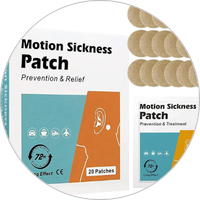 I got these Sea Sicknes Patches (Canada) and the reviews are great. or side effects. The herbal formula is safe and effective for men, women, teens, and kids four years and up to relieve motion sickness. It’s 100% Natural Herb with no pills and they offer complete relief without the side effects associated with pills and other medications.
Acupressure Wristbands
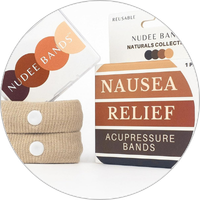 I get acupuncture once a month so I know this point all too well. Products like these Acupressure Sea Bands apply gentle pressure to the P6 (Nei-Kuan) acupressure point on the inner wrist. I swear by this acupressure point and use it all the time, especially during landings on the plane and it almost always immediately relieves the nausea. There are no side effects either!
Eat Light and Stay Hydrated
 An empty stomach and a greasy, heavy stomach are both miserable companions on a rocky ship. Stick to light, bland foods during rough patches – crackers, bread, bananas. Ginger in any form (ginger ale, ginger candies, ginger tea) has genuine anti-nausea properties. These are the Ginger Chews I get all the time (even just going about my day to day), they are tasty, and they work like a charm!
Get Fresh Air and Fix Your Gaze
If you start to feel queasy, head outside to an open deck at the midship level and look at the horizon. This gives your eyes and inner ear the same information – movement – and helps resolve the sensory conflict causing your nausea.
Avoid reading or screens below deck. Looking down at a book or phone while the ship is moving is a fast track to feeling terrible. Save the reading for when you’re in port or sitting on deck with a steady horizon in view.
>> Want to know more about Lifeboats on Cruises? From toilets to rations, here are 10 things you need to know. Read my article to find out!
4. Feeling Trapped: Addressing the “What If I Hate It” Fear
Another deeply human fear of cruising is the sense that once you’re at sea, you’re locked in. There’s no checking out early. No catching a taxi home. You’re committed.
This is understandable: but it misrepresents what life on a cruise ship is actually like. Modern cruise ships are floating cities. A large ship might have 20+ restaurants, Broadway-style entertainment, pools, spas, rock climbing walls, go-kart tracks, surf simulators, comedy clubs, art galleries, and libraries. If you’re not enjoying the port of call, you don’t have to get off. If you’d rather skip the show and sit quietly at the aft bar watching the ocean, that’s your vacation too.
The “trapped” feeling tends to evaporate within hours of departure for most first-time cruisers, who quickly discover there’s more to do than they’ll ever have time for.
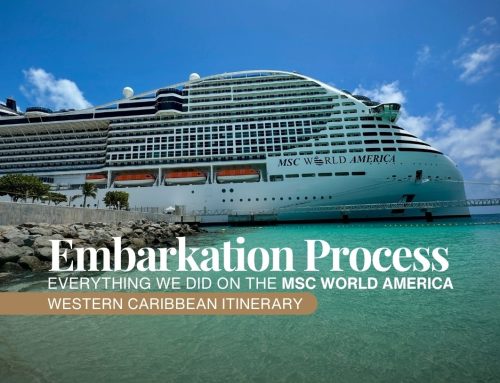
I get it because I actually hate flying simply because of claustrophobia. But a cruise ship is much larger than an airplane. And if you go on a mega cruise ship, like the one we just went on (MSC World America), that houses 6700 passengers, here are the stats for a ship this size:
- Walking Time: from the very front (bow) to the back (stern) of this ship at a normal, uninterrupted pace will take you roughly 5 to 6 minutes.
- Comparative Scale: It is nearly as long as 3.5 football fields lined up end-to-end, or roughly the height of the Eiffel Tower if stood vertically.
That’s pretty big.
5. Short Port Days and Not Enough Time to Explore
This is the one fear I actually agree with, so let me not pretend otherwise. On our Eastern Caribbean sailing, San Juan and Puerto Plata both felt like a tease, in the best and worst way. We got just enough of each to make a mental note: “come back here properly, without a ship waiting on us.“
One valid criticism that does come up among cruise travellers is the feeling of not having enough time in port. And this is worth addressing honestly, because it’s a real trade-off, not just an irrational fear.
I had a friend once tell me after they have cruised: “I felt like I saw everything and nothing at the same time.”
On a typical cruise itinerary, you might spend 8 to 10 hours in a given port city before returning to the ship. For a traveler who wants to wander narrow cobblestone alleys for three days, rent a scooter, eat at every local restaurant, and get truly lost in a place, a cruise isn’t going to scratch that itch entirely.
But here’s the nuance: a cruise is not meant to replace deep immersion travel. It’s designed to give you a taste, a curated sample platter of destinations that helps you figure out where you actually want to go back and spend your actual two weeks. Countless cruisers have said their favourite travel discovery was a port city they had no expectations for, which they later returned to independently because of a single cruise stop.
And for many people, especially those balancing limited vacation days and busy lives, getting to see Rome, Naples, Dubrovnik, Kotor, and Santorini all in one trip, even briefly, is infinitely better than choosing just one.
6. Cruising vs. Backpacking: The Cost Comparison Nobody Talks About
This is the argument that actually convinced my husband, a guy who has priced out enough tours logistics for production, musicians and artists over the span of thirty years to smell a bad deal from across a room.
Perhaps the most underrated argument against the fear of cruising is pure economics.
Let’s say you want to visit five countries in Europe over 10 days. If you go the backpacking route, the “real travel” approach, you’re looking at:
Flights between cities: $150–$400 per leg
Hostels: $150-250 per night
Meals: $30–$60 per day
Local transport (trains, buses, taxis): $20–$50 per day
Activity and entrance fees: $20–$80 per day
Plus the exhausting cycle of packing, unpacking, repacking, hauling luggage across train stations, navigating unfamiliar transit systems, and losing sleep in rotating accommodations
When you add it all up, a 10-day European backpacking trip through five countries can easily run $3,500–$6,000 per person, and that’s traveling lean. Now, if you have a family, you can add on your 2 -3 kiddos, and you are well almost at 20k+.
A comparable Mediterranean cruise, same five countries, similar timeline, can be found for $800–$2,500 per person, often including all meals, onboard entertainment, accommodation, and port access. Even with shore excursions and gratuities factored in, the cruise typically wins on cost.
Beyond the money, there’s the mental load of independent multi-destination travel. Every day you’re researching the next city, checking into a new place, figuring out the local transit, and wondering if you packed right. On a cruise, you unpack once, sleep in the same bed every night, and wake up in a new country with a cup of coffee in your hand. Your floating hotel does all the moving for you.
Give Cruising a Real Chance
The fear of cruising is real, but it is overwhelmingly built on imagination rather than experience.
- The safety record of modern cruise ships is extraordinary. Crew training is rigorous and internationally certified.
- Motion sickness is manageable and often non-existent.
- The feeling of being trapped dissolves quickly once you realize you’re on a ship with more amenities than most land-based resorts.
- Yes, port days are short. But they open doors rather than close them.
- And when you stack the cost of cruising against independent backpacking, the cruise wins on value nearly every time. Without the exhausting logistics of packing and unpacking your way across a continent.
If you’ve been living with a fear of cruising, the best cure is simple: book a short sailing, I say 2-4 nights, and see for yourself. These prices are also always great to test the waters (no pun intended)! The ocean is far less frightening from the deck of a modern cruise ship than it is from the shore of your imagination.
Have I helped you get over your fear of cruising? 😉

RECENT POSTS




















Hey, I’m Marina! Your Canadian travel points enthusiast with a love for elevated stays who also happens to have serious obsession with cruising. I share real-world tips, strategies, and lessons from my own travels to help you unlock luxury experiences without the luxury price tag.
Love What I Wrote? Please Share! ♥