How to Travel Free with Points
Showing you the best places to wander and how to choose the best travel rewards credit cards that turn everyday spending into free flights, hotel stays, and upgrades.
Lifeboats on Cruises: 10 Crucial Things You Need to Know
THE GEN X WANDERER / Lifeboats on Cruises
TABLE OF CONTENTS
Lifeboats on Cruises: Titanic Changed Everything
Most people board a cruise ship, glance at those big orange boats hanging off the sides, and don’t give them a second thought. But if you’ve ever quietly wondered what actually happens if you end up in one, you’re not alone. Lifeboats on cruises are way more interesting (and far more sophisticated) than you might expect.
And, you can’t talk about lifeboats on cruises without acknowledging the Titanic, because almost everything about modern maritime safety traces back to April 1912.
When the Titanic sank, she carried roughly 2,200 people but only had lifeboat capacity for about 1,178, barely half. The phrase “women and children first” became permanently associated with that night, though it was never actually a maritime law. Captain Edward Smith gave the order to prepare the lifeboats, and officers on each side of the ship interpreted it differently, some let men board once women and children had taken their seats, while others refused men entirely. In the end, about 74% of the women on board survived, 52% of the children, and only 20% of the men.
The phrase itself predates the Titanic, its first recorded use appeared in an 1860 novel, but the disaster cemented it in the public imagination forever.
MSC World America ~ Lifeboats
Today, there is no “women and children first” rule in international maritime law.
Under current IMO regulations, cruise ships have 30 minutes to load all passengers and clear the lifeboats from the side of the ship. Everyone boards based on their muster station assignment, not their gender or age. The emphasis now is on speed, order, and trained coordination, a far cry from the improvised chaos of a freezing April night in the North Atlantic.
The governing body behind all of this is the International Maritime Organization, which enforces the International Convention for the Safety of Life at Sea, commonly called SOLAS. They was first drafted in 1914 as a direct response to the Titanic disaster. It’s been updated many times since, and today it sets the global floor for everything from lifeboat construction to mandatory drills.
OK. So let’s walk through all of it: how many are on board, what you’d eat, the bathroom situation (yes, we’re going there), what a muster station actually is, and the remarkable technology keeping cruise passengers safe in the modern era. Here are 10 things you need to know about lifeboats on cruises.
>> Incase you have missed it, be sure to read my article about Fear of Cruising: 6 of Your Biggest Worries are Probably Wrong
1. What Is a Muster Station?
If you’ve been on a cruise, you’ve been to your muster station, even if you didn’t know exactly what to call it.
A muster station is your designated emergency assembly point. Every cabin on the ship is assigned to a specific one, usually based on where your room is located. These spots are typically on the open decks near the lifeboats, and they’re clearly marked with signs throughout the ship.
Before any cruise departs, everyone on board, passengers and crew, must complete what’s called a muster drill (sometimes referred to as a safety drill or lifeboat drill). It’s a legal requirement under SOLAS, and it has to happen within the first 24 hours of departure. Usually, after boarding a cruise ship, this is immediate. The drill teaches you where your muster station is, how to put on a life jacket, which escape routes to use, and what the emergency alarm sounds like.
The traditional version involved everyone gathering at their station at the same time, which meant a lot of shuffling through narrow corridors holding life jackets. I’ve done this drill more times than I can count now, and it’s never fun, shuffling through a hallway holding a life jacket while trying not to elbow a stranger.
However, after covid, many cruise lines have now moved to a digital “e-muster” system where you watch a safety video on your phone or cabin TV and then visit your station on your own schedule to have your cruise card scanned. Royal Caribbean’s version is called eMuster, and Celebrity Cruises runs a system called Muster 2.0. It usually takes less than 10 minutes, and then you’re free to head to the pool bar.
Our MSC World America muster was also an e-muster, I watched the safety video from our balcony with a coffee, walked down, got my card scanned, and was back at the pool bar before my husband even finished his video. If your last cruise was pre-2020 and you’re dreading this part, it’s a completely different experience now.
2. How Many Lifeboats are on a Cruise Ship?
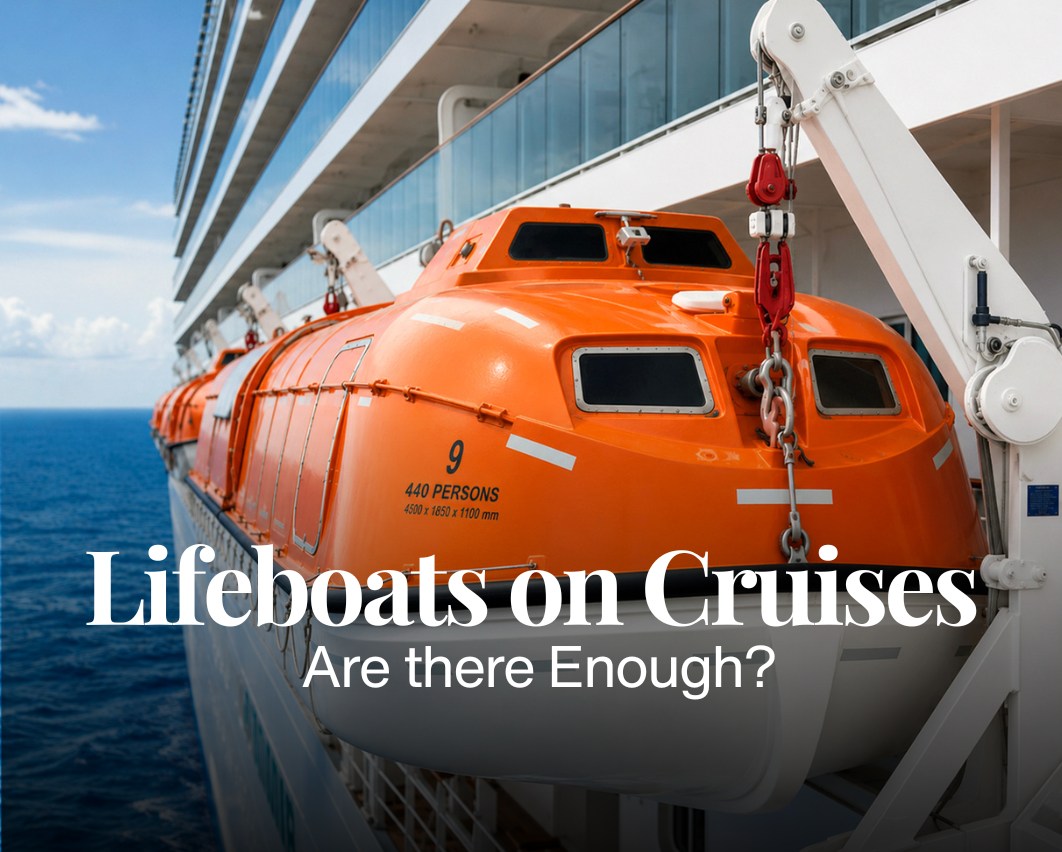
The number depends on the size of the ship, but here’s a rough idea of how it breaks down. Large cruise ships carrying several thousand passengers typically carry between 16 and 20 enclosed lifeboats. Older-style lifeboats held around 150 people each. Newer models designed for today’s mega-ships can hold 300 to 450 passengers, Royal Caribbean’s Icon of the Seas, for example, carries lifeboats with a capacity of 450 people per boat.
Under SOLAS, every cruise ship must carry lifeboats on each side of the vessel capable of holding at least 37.5% of everyone on board. Since there are two sides, that works out to coverage for 75% of the total headcount, passengers and crew combined. The remaining 25% is covered by inflatable life rafts.
In practice, most ships actually carry capacity well beyond the minimum. When you add the life rafts on deck (those white drum-shaped canisters you see strapped to railings), the combined capacity typically exceeds 125% of the total number of people on board. So the answer to the question “are there enough lifeboats for everyone?” is: yes, and then some.
3. What’s Actually Inside a Lifeboat on a Cruise?
Modern enclosed lifeboats are a lot more capable than most people picture. They look more like a small submarine with windows than a rowboat. Here’s what you’d find inside.
4. Food and Water
Each person on the lifeboat is provided with at least 3 litres of fresh water and enough food to supply roughly 2,390 calories, the equivalent of about a full day’s nutrition. The food itself is almost certainly going to be high-calorie emergency biscuits made by a brand called Seven Oceans (or similar). Each box contains 9 dense, nutrient-packed biscuits subdivided into tablets, vacuum-sealed and wrapped in watertight foil. They’re not winning any culinary awards by any means, but the goal is survival, and they’re designed to last for years without refrigeration. Most lifeboats carry a week’s supply. There are also three can openers on board, because apparently international maritime law has opinions about can opener redundancy.
Watch a behind the scenes video on our Safety Boats work.
5. Other Supplies
Beyond the food and water, you’d find first aid supplies, seasickness medication and bags (important, because a lifeboat bobs considerably more than a cruise ship), a compass, hand flares, parachute flares, orange smoke signals for signalling passing aircraft or ships, a searchlight, thermal protective suits for 10% of capacity, a survival manual, a jackknife, and a fire extinguisher.
6. The Bathroom Situation
This is probably the question most people are actually thinking about. Older, smaller lifeboats, the 150-person variety, typically have no formal toilet. There are plastic bedpan-style containers on board, and waste goes overboard. Not glamorous, but modern rescues are generally fast enough that it rarely becomes a serious issue.
Larger modern lifeboats designed for today’s mega-ships, like those on Royal Caribbean’s Oasis-class vessels, do include a basic toilet behind a small privacy partition. It’s not a luxury bathroom, but it’s there.
7. Addressing Claustrophobia
This is worth mentioning honestly. An enclosed lifeboat is a small, sealed fiberglass shell with very limited space per person. On one well-known Virgin Voyages ship, the Valiant Lady, a single lifeboat holds over 300 passengers. People sit in three layers, essentially between the legs of the person in front of them. There are 14 crew members seated among the passengers to manage supplies and organization. It’s close quarters by any standard. If you’re someone who struggles with enclosed spaces, this is worth knowing ahead of time, though again, the whole point of these vessels is that you’d only ever be in one for the shortest possible time before rescue arrives. This is all about survival now.
I’m not someone who deals well with tight spaces (don’t ask me about the severe panic attack I had on my flight on a small Porter Airplane) so when I read that a Valiant Lady lifeboat seats 300 people in three stacked layers, I had a genuine moment of “ABSOLUTELY NOT.” But I’ll be honest, standing on our own ship’s deck and actually looking at the size of the lifeboats hanging off the side made me feel better, not worse. They’re bigger and more solid than they look from a pool chair.
8. Crew Training: It’s More than You Think
The crew members guiding you to a lifeboat haven’t just read a pamphlet. Every single person who works on a cruise ship, from the captain down to the staff at the guest services desk, must complete what’s called STCW Basic Safety Training before they ever set foot on a vessel. STCW stands for Standards of Training, Certification and Watchkeeping, and it’s the global framework set by the International Maritime Organization.
The basic package is a five-day course that covers personal survival techniques, fire prevention and firefighting, elementary first aid, and personal safety and social responsibilities. The survival techniques portion alone is two full days, including classroom instruction and hands-on practical sessions in the water. STCW certificates need to be renewed every five years.
Beyond that baseline, crew members assigned to lifeboat duty complete additional specialist certification covering the actual operation of lifeboats and rescue craft. Officers who oversee crowd management and evacuation during emergencies complete separate crisis management training. On top of all the initial certification, every ship conducts regular drills and inspections: visual lifeboat checks happen weekly, engines are run for at least three minutes, and a full inspection by certified personnel takes place annually.
When you see the crew doing a lifeboat exercise in port, it’s not a formality, it’s a mandatory operational check.
9. The Marin-Ark: A Different Way to Evacuate
Traditional enclosed lifeboats hanging from davits (the mechanical arms that lower them) aren’t the only evacuation tool on modern cruise ships. Enter the Marin-Ark, a marine evacuation system (MES) made by Survitec that represents a completely different approach to getting thousands of people off a ship fast.
The Marin-Ark works through an enclosed helical slide system, essentially a spiral tube that passengers descend from the ship’s deck down into large, self-inflating life rafts in the water below. Think of it as a water park slide, except enclosed, mounted on the side of a ship, and very serious.
The system was developed in part as a response to the Estonia disaster in 1994, when 900 people died in the Baltic Sea and many life rafts deployed upside down. The Marin-Ark’s life rafts are fully reversible with six separate buoyancy chambers, far more than the two chambers found in standard life rafts. The telescopic design of the slide adjusts for the movement of both the ship and the sea, keeping the chute usable even in rough conditions.
A single Marin-Ark 2 system can be configured to evacuate up to 860 people in under 30 minutes, a number that would take many more traditional lifeboats to match. The system takes up far less deck space than an equivalent number of conventional lifeboats, which matters a lot on ships carrying 5,000 or more passengers. More than 100 Marin-Ark 2 units have been installed on vessels around the world, including large ferries and cruise ships.
10. Are Cruise Ships Safe?
Genuinely, yes. Statistically, cruising is one of the safer ways to travel. The combination of SOLAS regulations, mandatory crew training under STCW, modern lifeboat technology, and continuous drills means that cruise lines are operating under some of the most rigorously enforced safety standards in the transportation industry.
Lifeboats on cruises have come an enormous distance from the wooden vessels lowered by hand ropes in 1912. Today’s enclosed, motorized, GPS-equipped, supply-stocked boats, and the sophisticated evacuation systems that complement them, exist because the maritime industry has spent over a century learning hard lessons and building better answers.
All of this research made me feel weirdly better about something I used to not think about at all. I used to walk past those orange boats without a second glance. Now I actually look up at them and feel a little reassured, which is a strange thing to say about emergency equipment, but here we are.
So the next time you spot those bright orange boats hanging off the side of your ship, you can appreciate them for what they really are: a remarkably well-thought-out last line of defense that you’ll almost certainly never need.
RECENT POSTS














Hey, I’m Marina! Your Canadian travel points enthusiast with a love for elevated stays who also happens to have serious obsession with cruising. I share real-world tips, strategies, and lessons from my own travels to help you unlock luxury experiences without the luxury price tag.
Love What I Wrote? Please Share! ♥